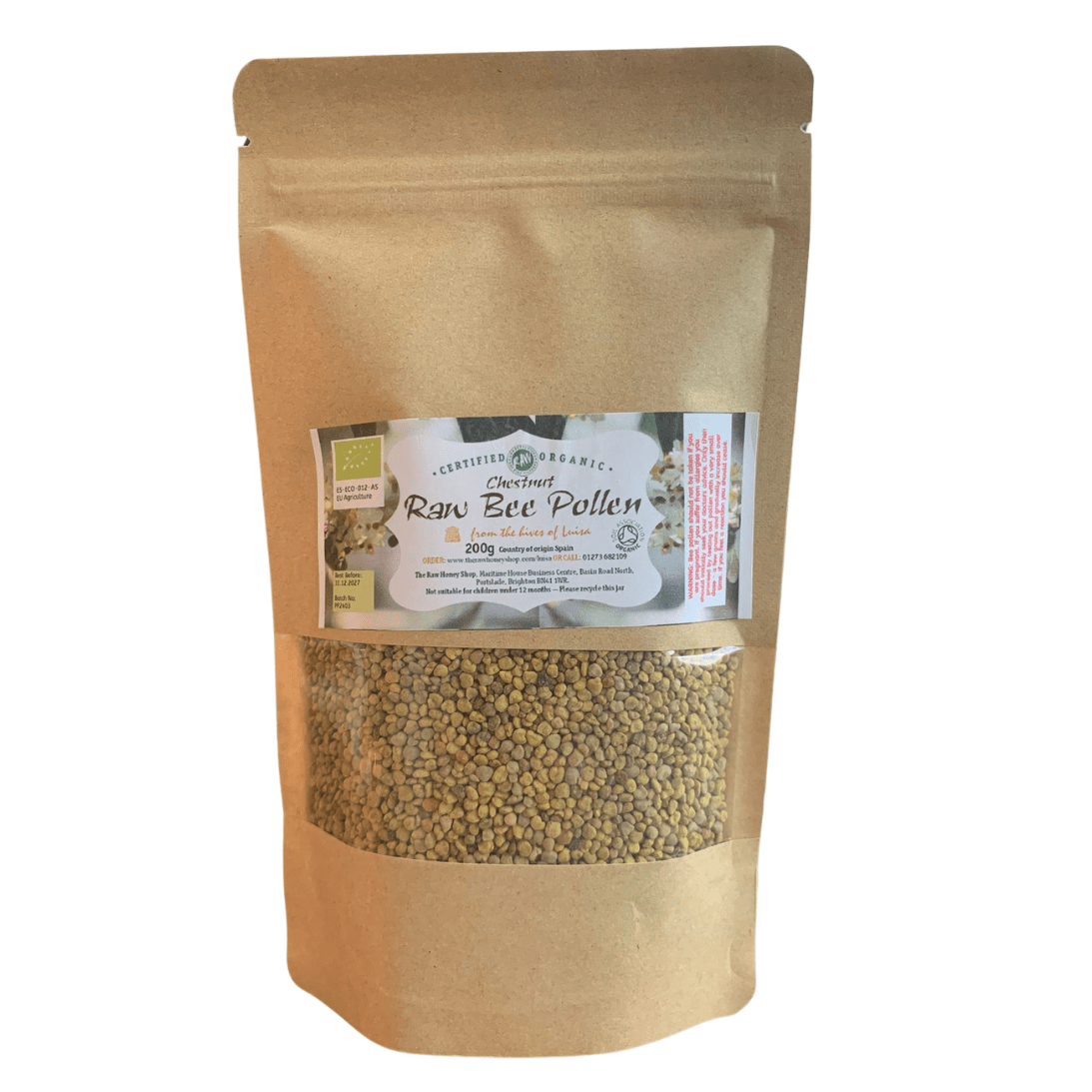


Dried Raw Organic Chestnut Bee Pollen – 200g
Pure, raw, and harvested from a remote, pristine environment, this chestnut bee pollen is among the purest you can find.
Origin
Luisa’s Dried Raw Organic Chestnut Pollen is sourced from the unspoilt Cantabrian Mountains and rolling hills of Asturias, located in the lush north of Spain. The pollen is rich in long-chain fatty acids, vitamins, minerals, trace elements, and natural enzymes from the bees.
Flavour Profile
This pollen offers a subtle bitterness balanced by a beautiful floral aroma, complemented with deep, earthy undertones.
Source Tree
The pollen is collected from the blossoms of the Chestnut tree.
Appearance
You’ll notice a striking mix of dark yellow and orange grains, with occasional hints of purple and deep blue.
Producer
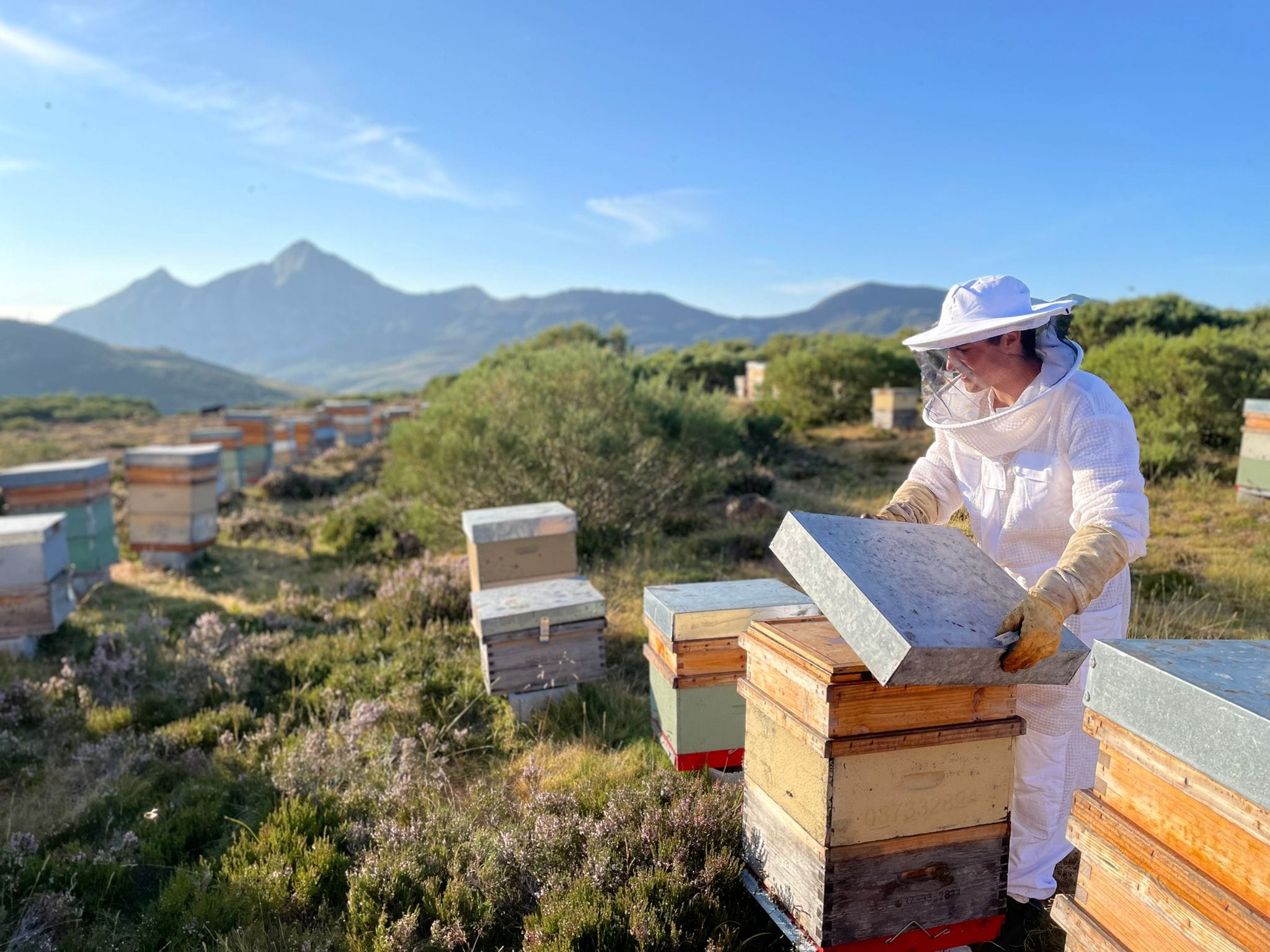
While the bees gather the pollen, the hives are carefully tended by Luisa and her daughter Olaya, passionate beekeepers dedicated to producing the highest quality raw honey and bee products, paying close attention to every detail.
Common Uses
Historically valued as a nourishing food, bee pollen is versatile: sprinkle it on yoghurt or cereal, blend it into smoothies, or mix it into salad dressings. Just avoid heating it to preserve its valuable nutrients.
Interesting Facts
Bee pollen has been cherished throughout history. The ancient Greeks and Romans called it “the life-giving dust” or “ambrosia,” believed to grant eternal youth. It was buried with pharaohs, used by Native Americans, and treasured for centuries by tribes in China.
Harvesting Method
Bees collect pollen in their pollen sacks and bring it back to the hive to feed the brood, which requires high protein. Beekeepers harvest small amounts by placing brushes at the hive entrance, gently collecting pollen grains without disrupting the bees’ natural activities.
Important Allergy Information
If you suffer from hay fever or pollen allergies, be cautious. Start by taking only a few grains and wait to see if there is any reaction. If all is well, slowly increase your intake. If you experience any adverse effects, discontinue use.
Dried Raw Organic Chestnut Bee Pollen - 200g
- Regular price
- £23.99
- Sale price
- £23.99
- Regular price
-
Our Returns and Refund Policy
This policy applies to our retail orders only. If you are a trade customer, please contact us directly.
HOW DO I MAKE A RETURN?
If your order arrives and there is a problem then please email us at info@therawhoneyshop.com or call us on 01273 682109. Include your order number if possible and details of the problem. If it is necessary to return the order, the product must be returned to us unopened and in the same condition as when it arrived. So please re-pack it with care using the original packaging or a suitable alternative and we can supply you with a freepost label. If we need to issue a refund, once we have the package back with us, we will issue you a full refund or replacement.
IMPORTANT: If your order has arrived damaged, then please dispose of any broken jars and glass safely and quickly. Please do not attempt to wash or clean the jars as there may be small chips that can cause cuts.
Contact us at info@therawhoneyshop.com and let us know the details, including your order number and if possible, attach pictures. These are helpful for us in terms of improving our processes and for any claims we may make against the carrier.
We will resolve this issue by either sending you a new product straight away or refunding your order in full.
If your order is a large tin or tub weighing over 1kg and arrives damaged:-
Unfortunately, we cannot accept returns on tins or tubs of over 1kg. If your tub or tin arrives slightly damaged and leaking, we are happy to give you a partial refund on the amount of honey you feel has been lost. Unfortunately, we cannot replace whole tins or tubs unless more than 50% of the honey has been lost. We would then request you send us pictures so that we can assess the damage and agree the replacement.
Sale items are sold as per the description and we cannot accept any returns.
We hope that you will never be unhappy with any honey that you buy from us, but if on the rare occasion that this does happen, please do get in touch with us as soon as you can, and we will be happy to find a solution for you.
Our Returns Policy
If there is a problem with your honey - provided no seals have been broken and the product has not been opened (i.e.: it must be in 'new' condition) you can return your honey to us up to 35 days after you have made your order. Excluding sale items which are sold as per the description and cannot be returned.
We will process your refund within 14 days of having received the returned good(s) or proof of having returned the goods (for example, a proof of postage receipt from the post office), You will be refunded for the full cost of the product(s) as well as any original shipping fees paid.
If you are returning part of a larger order, you may only be refunded a portion of any shipping fees paid.
Please note we cannot issue refunds or replacements for honey because it has crystallised.
We indicate on the website the state of each honey - either runny or crystallised but this information is based on the best of our knowledge and the state can change quickly – particularly in the colder months of the year. The crystallisation process is completely natural (even processed honey will crystallise eventually). If we have indicated that the state is runny and it is crystallised when you receive it - this simply means that it has crystallised quicker than we expected, which can happen. It does not indicate that there is a problem with the honey and therefore is not covered by our returns policy.
Please note that refunds on items bought as gifts can only be issued to the original purchaser.
The Raw Honey Shop reserves the right to apply and interpret this extended returns policy as it decides is most appropriate.
Consumer Contracts Regulations
If you have purchased our products online or over the phone, you will be covered by the statutory Consumer Contracts Regulations.
Consumer Contracts Regulations do not apply to perishable items (eg: fresh royal jelly and fresh bee pollen) or goods with a seal for health protection and hygiene reasons that's been broken.
If the item(s) you receive is somehow faulty or otherwise not as described, your right to return your item(s) is covered under the Consumer Rights Act 2015.
If you have any questions or need assistance with this, please contact us at info@therawhoneyshop.com or call on +44 (0) 1273 682109.
Dried Raw Organic Chestnut Bee Pollen – 200g
Pure, raw, and harvested from a remote, pristine environment, this chestnut bee pollen is among the purest you can find.
Origin
Luisa’s Dried Raw Organic Chestnut Pollen is sourced from the unspoilt Cantabrian Mountains and rolling hills of Asturias, located in the lush north of Spain. The pollen is rich in long-chain fatty acids, vitamins, minerals, trace elements, and natural enzymes from the bees.
Flavour Profile
This pollen offers a subtle bitterness balanced by a beautiful floral aroma, complemented with deep, earthy undertones.
Source Tree
The pollen is collected from the blossoms of the Chestnut tree.
Appearance
You’ll notice a striking mix of dark yellow and orange grains, with occasional hints of purple and deep blue.
Producer
While the bees gather the pollen, the hives are carefully tended by Luisa and her daughter Olaya, passionate beekeepers dedicated to producing the highest quality raw honey and bee products, paying close attention to every detail.
Common Uses
Historically valued as a nourishing food, bee pollen is versatile: sprinkle it on yoghurt or cereal, blend it into smoothies, or mix it into salad dressings. Just avoid heating it to preserve its valuable nutrients.
Interesting Facts
Bee pollen has been cherished throughout history. The ancient Greeks and Romans called it “the life-giving dust” or “ambrosia,” believed to grant eternal youth. It was buried with pharaohs, used by Native Americans, and treasured for centuries by tribes in China.
Harvesting Method
Bees collect pollen in their pollen sacks and bring it back to the hive to feed the brood, which requires high protein. Beekeepers harvest small amounts by placing brushes at the hive entrance, gently collecting pollen grains without disrupting the bees’ natural activities.
Important Allergy Information
If you suffer from hay fever or pollen allergies, be cautious. Start by taking only a few grains and wait to see if there is any reaction. If all is well, slowly increase your intake. If you experience any adverse effects, discontinue use.